Why Can't ChatGPT See My Website? We Hid 3 Words to Find Out
We put 3 made-up words on one page, 2 of them added by JavaScript, then asked Claude, ChatGPT and Perplexity to read it. Here is what each one read, and how to check your own site.
In short
- ChatGPT and Claude read the HTML your server sends and do not run the page's JavaScript, so anything that appears after the page loads is missing for them.
- On our test page, Claude read word 1 and saw "loading" for words 2 and 3. ChatGPT's agent downloaded the page once and never fetched the code that fills in the other two.
- Perplexity's API could not open the page at all, in 10 of 10 tries.
- Check your own page in 30 seconds: view the page source and search for your price. If it is not there, AI tools cannot see it either.
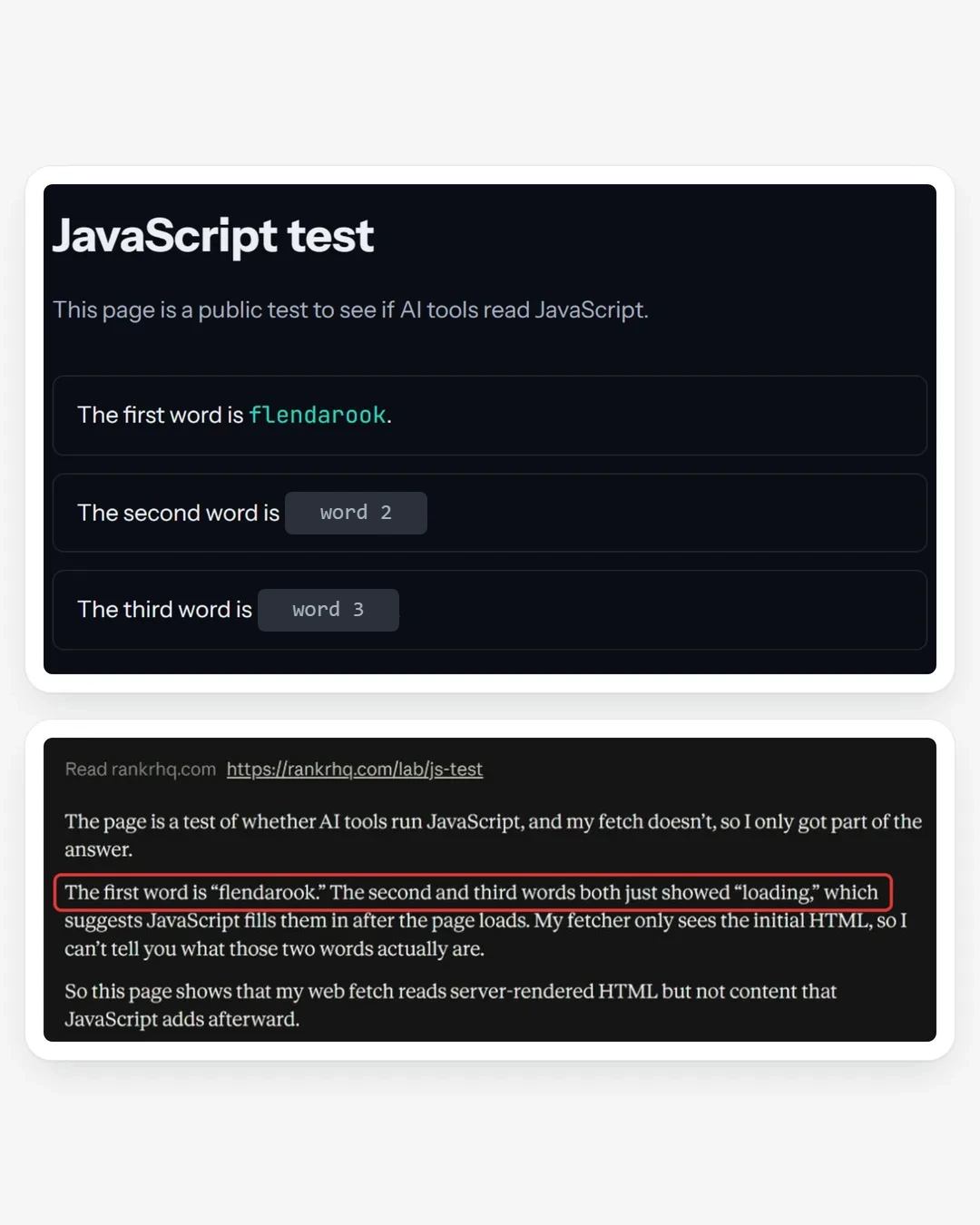
If ChatGPT can't see your website, a common cause is that the words it needs are put on the page by JavaScript after the page loads. ChatGPT reads the HTML your server sends first and does not run that code, so prices, reviews or whole pages that arrive later never reach it. At rankr we build and fix websites so every word a customer needs is in that first response, and this is the test we ran on our own site to show the difference.
What did we test?
On 26 September 2026 we published a test page, rankrhq.com/lab/js-test, with 3 made-up words on it. Each word reaches the page a different way.
| Word | How it gets onto the page |
|---|---|
| flendarook | Written into the HTML the server sends. Reading it needs no JavaScript |
| word 2 | Requested from our server by the page's JavaScript after the page loads. Reading it proves the JavaScript ran and made a request |
| word 3 | Written in by the page's JavaScript, with no request. Reading it proves the JavaScript ran |
Until the JavaScript runs, lines 2 and 3 read "The second word is loading." and "The third word is loading." A person opening the page in a browser sees all 3 words. We name only the first one here, because a tool that read words 2 and 3 in this article could repeat them without running anything. Our server logs record every request for the page, for the second word and for the file that holds the third, with the name each visitor's software gives itself, so an AI tool's answer can be checked against what its agent downloaded.
What did each AI tool read?
| Tool, date and question | What it read, and what our server logged |
|---|---|
| Claude app, 18 Oct 2026, asked for the 3 words | Read flendarook. Said words 2 and 3 "both just showed 'loading'". Server: 1 page request from Claude's agent, no request for word 2, no download of the page's JavaScript |
| ChatGPT, through OpenAI's API with web search, 18 Oct 2026, asked 10 times for the first word | Read flendarook, 10 of 10. Server: 1 page request from ChatGPT's agent, no request for word 2, no download of the page's JavaScript |
| Perplexity, through its API, 18 Oct 2026, asked 10 times for the first word | "I can't open that page", 10 of 10. Server: no request |
Claude explained it in its own answer: "My fetcher only sees the initial HTML, so I can't tell you what those two words actually are." Claude's web fetch gave the same result when we first ran the test on 26 September.
ChatGPT's answer only shows that it read word 1, because word 1 is what we asked for. The evidence that it skipped the JavaScript is in our logs: its agent fetched the page once and requested nothing else from it. Between 26 September and 26 October, the second word was requested 14 times and the file holding the third word was downloaded 12 times, every time by a web browser or our own check, never by software that identified itself as an AI tool.
Two things we have not tested: Gemini, and the ChatGPT app as opposed to OpenAI's API. Vercel's crawler study, below, reports that Gemini uses Googlebot's infrastructure, which does run JavaScript.
Does ChatGPT run JavaScript?
No, on every piece of evidence we have. Vercel studied AI crawlers across its network and reported on 17 December 2024 that "none of the major AI crawlers currently render JavaScript", naming the crawlers of OpenAI, Anthropic, Meta, ByteDance and Perplexity. ChatGPT's crawler did download JavaScript files, 11.50% of its fetches, but did not run them. Google was the exception: Gemini uses Googlebot's infrastructure, which renders pages fully.
Our test is newer and much smaller than Vercel's, and it agrees for ChatGPT and Claude.
What on a business website usually loads too late?
The parts of a page that sell are often the parts added by code after it opens:
- prices pulled in by a booking or pricing plugin
- star ratings and reviews shown through a review widget
- quote forms and price calculators
- menus, timetables or stock levels loaded from another system
- every page of a site built as a single-page app, where the server sends an almost empty page and JavaScript draws the rest
A customer on your website sees all of it. ChatGPT reads the same page with those parts missing, so when someone asks it what you charge, it has nothing from your own site to quote.
How do you check what ChatGPT can see on your website?
- Open the page on a computer, right-click and choose View page source (Ctrl+U on Windows).
- Press Ctrl+F and search for your price, a line from a review, or a service name.
- If the text is in the source, it was in the HTML your server sent and ChatGPT can read it. If it is not, it arrives later through JavaScript, and AI tools that do not run code cannot see it.
Our free AI visibility checker runs the same check on any page and also reads your robots.txt.
What else stops ChatGPT from seeing a website?
If your words are in the page source and ChatGPT still can't see the site, check three more things.
- robots.txt. OpenAI's crawler documentation says a site that wants to appear in ChatGPT's search should allow OAI-SearchBot in robots.txt. Sites that block it "will not be shown in ChatGPT search answers".
- Cloudflare. On 1 July 2025 Cloudflare started blocking AI crawlers by default and asking every new domain at sign-up whether to allow them. If your site is behind Cloudflare, check that setting.
- Whether the tool can open your page at all. Perplexity's API could not open our test page in 10 tries, even with its exact address. The page is set to noindex and nothing links to it, which is the likely reason a tool that answers from its own search index had no copy. ChatGPT, given the same address, fetched it live.
OpenAI's own search tool was not consistent on this either. Run through OpenAI's Codex app on 26 September and again on 26 October, its web search could not open the test page, and no request from OpenAI reached our server.
How do you fix it?
Put the words that sell into the HTML your server sends:
- Type your prices, the areas you serve and a few review quotes into the page text, instead of relying only on a plugin to show them.
- Keep the widget for customers if you like it, and add a plain line of text beside it with the price or rating.
- If the whole site is drawn by JavaScript, ask your developer for server-side rendering or pre-built pages. Frameworks such as Next.js and Astro do both.
rankr, the agency that writes this blog, fixes this as part of technical SEO: we find what your pages hide from crawlers and move it into the HTML. When the site itself is the problem, we rebuild it in code with every word rendered on the server, the way we built rankrhq.com, where the text of every article and service page is in the HTML our server sends.
If the source check finds everything and the only gap is a robots.txt line or a Cloudflare setting, that is a small change your current developer can make.
How we tested
The test page went live on 26 September 2026. It is set to noindex, is not in our sitemap and has no links pointing to it. The Claude app was asked on 18 October 2026: "read this page and tell me the 3 words on it: https://rankrhq.com/lab/js-test". ChatGPT and Perplexity were asked through their APIs on 18 October 2026 (Singapore time), 10 times each: OpenAI's gpt-5.6-luna model with OpenAI's web search, and Perplexity's sonar model. Their prompt was: "Open https://rankrhq.com/lab/js-test and tell me the first made-up word on the page, exactly as written. If you cannot open it, say so." Server requests were counted from our Vercel logs by path and user agent on 26 October 2026.
Sources
- Vercel: The rise of the AI crawler, 17 December 2024
- OpenAI: Overview of OpenAI crawlers, read 26 October 2026
- Cloudflare: Cloudflare just changed how AI crawlers scrape the internet-at-large, 1 July 2025
Frequently asked questions
Why can't ChatGPT see my website?
Often because the text is added by JavaScript after the page loads, and ChatGPT reads only the HTML your server sends first. Other causes are a robots.txt file that blocks OAI-SearchBot, Cloudflare's AI crawler block, or a page the tool cannot find or open.
Can ChatGPT read JavaScript?
It reads the HTML a page sends and does not run the JavaScript. On our test page, ChatGPT's agent downloaded the page once and never fetched the code that adds the second and third words. Vercel's 2024 crawler study found the same for OpenAI's crawlers.
Why can't ChatGPT open some links?
Not every assistant fetches a page live. In our test, Perplexity's API could not open a page that is set to noindex, in 10 of 10 tries, while ChatGPT fetched the same address live. OpenAI's search through its Codex app also failed to open it, on 26 September and 26 October 2026.
How do I make my website appear in ChatGPT?
Put your prices, services and the areas you serve in the page text your server sends, allow OAI-SearchBot in robots.txt, and answer the questions customers ask in plain words on your pages. Then ask ChatGPT about your business and open the sources it lists.
Does noindex hide a page from ChatGPT?
Not when someone gives ChatGPT the address. Our test page is set to noindex, and ChatGPT's agent still fetched it when asked. OpenAI says robots.txt rules "may not apply" to ChatGPT-User, the agent that visits a page when a person asks a question.
We post findings like this on LinkedIn. Follow rankrHQ


Want this done on your site? You work with the founders, Abhishek and Abel. Get a free SEO audit or see pricing.