How our first client got cited by ChatGPT in two months
It should have been impossible. Our first client started at DR 0 with no backlinks, and ChatGPT was citing them within two months of us building the site. Here are the receipts, what held up when we removed personalisation, and what did not.
In short
- Our first client, Lullaflex, came to us with nothing online. We built their site from scratch. It started at domain rating 0 with no backlinks, and within two months ChatGPT cited it and it appeared in a Google AI Overview.
- In a clean logged-out search, Google's AI Overview cited established furniture sites on all eight queries we tested and never cited Lullaflex. That one was personalisation.
- The ChatGPT citation and the page-one ranking held up. The page won by stating concrete, extractable facts that matched the model's own criteria.
- You do not need years of backlinks to start showing up in AI answers. You need specific, citable facts on pages people actually ask about.
Lullaflex is rankr's first client. They came to us with nothing online: no domain, no site, no links. We built their mattress site from scratch, and it started at a domain rating of 0 with no backlinks. By ordinary SEO measures, the domain had almost no authority.
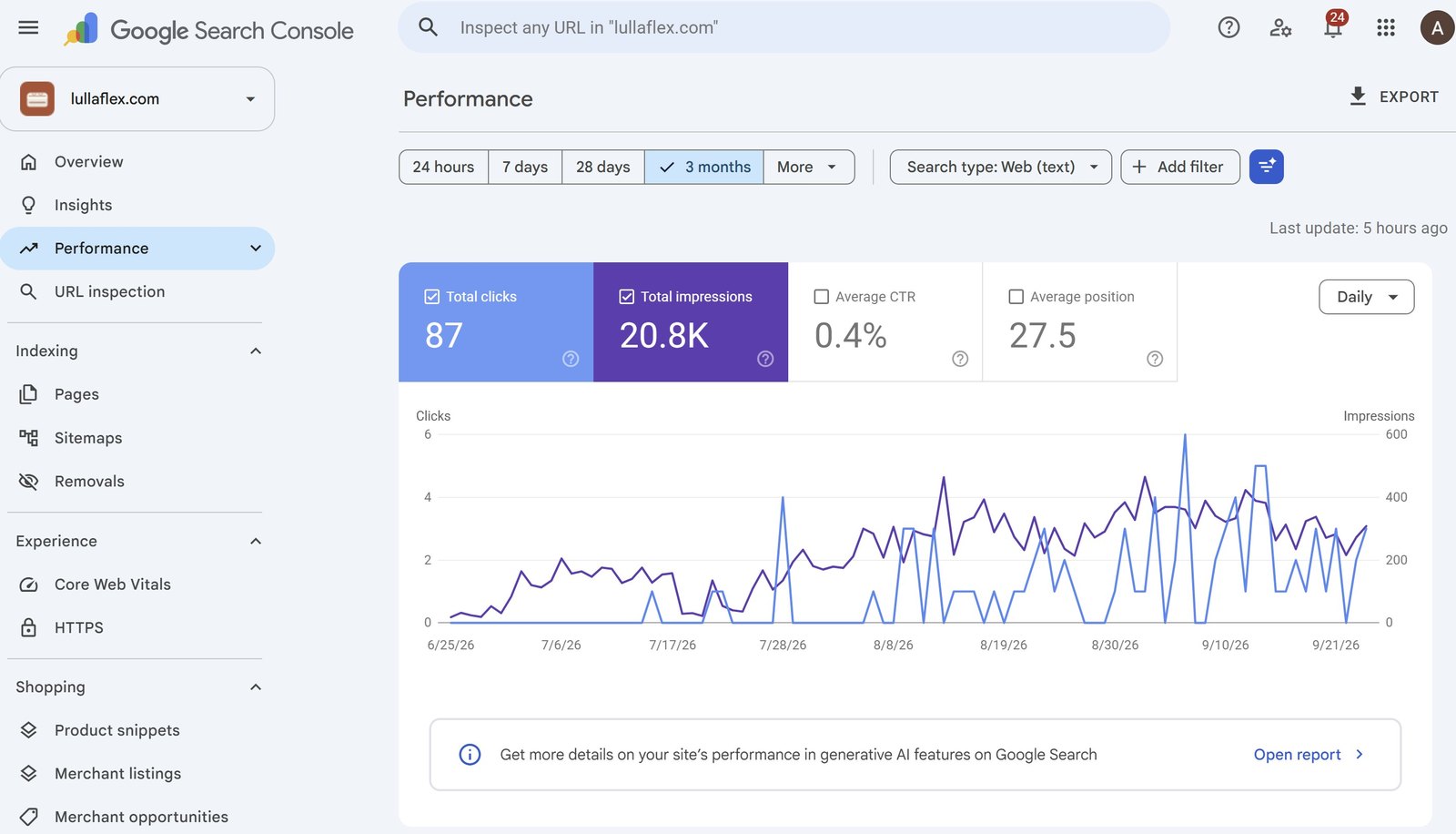
Then, within 2 months of us building the site, ChatGPT recommended it, Google's AI Overview quoted it, and it landed on page one of Google's normal search results. All three happened in the same week.
Here is exactly what happened, including the part most case studies quietly skip: one of those three wins did not survive a basic check.
ChatGPT put Lullaflex in the answer
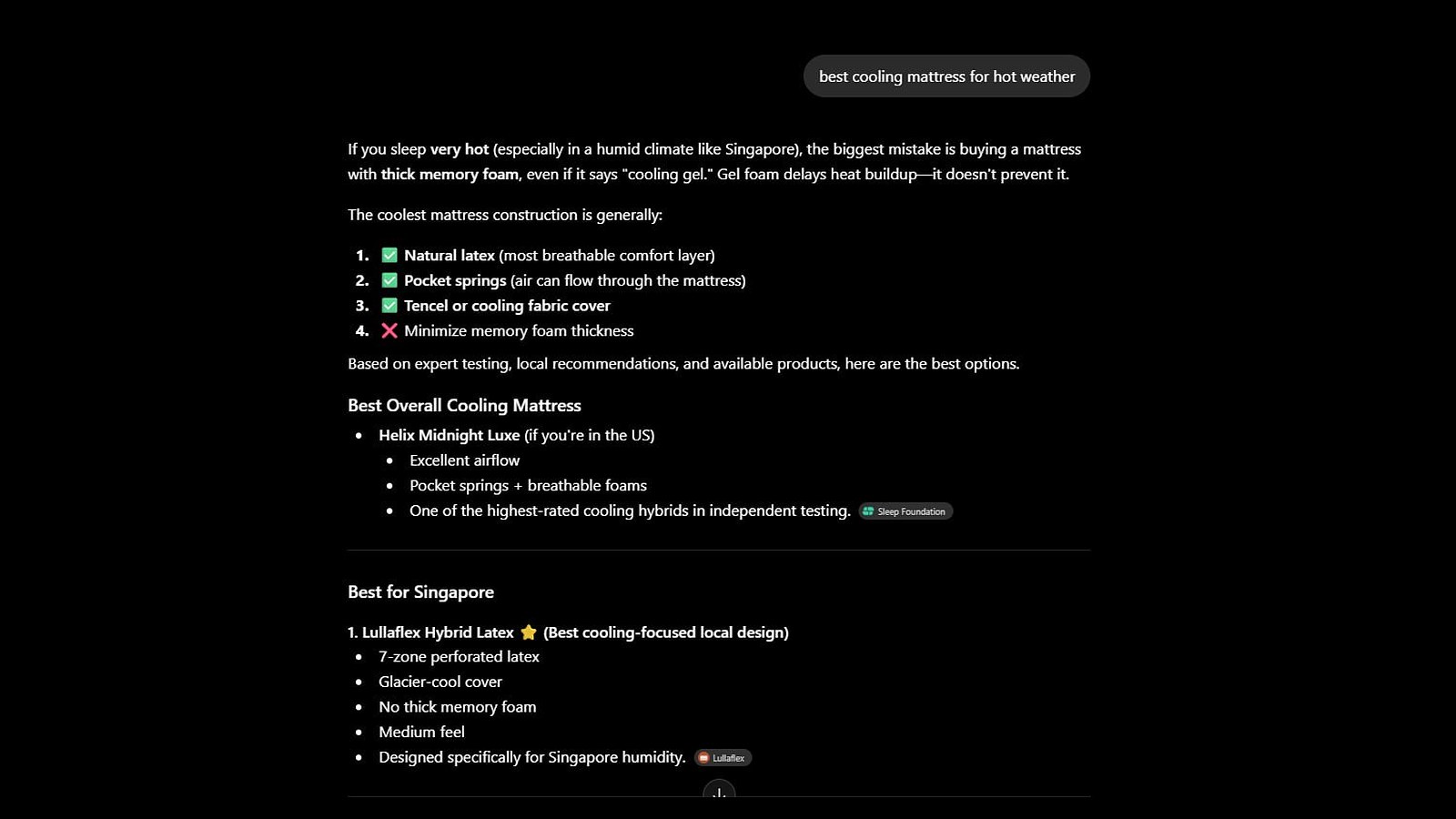
Someone asked ChatGPT for the best cooling mattress for hot weather. It laid out its own criteria first, natural latex, pocket springs, minimise memory foam. Then it listed the best options, and under "Best for Singapore" it named Lullaflex.
Nobody paid for that. The site had no reviews, no press and no backlinks. ChatGPT picked it because the page carried concrete facts that matched what it was looking for: seven-zone perforated latex, a cool-touch cover, no thick memory foam, built for Singapore humidity. The generic "10 tips for better sleep" pages that fill this niche never answered the actual question, so they were never in the running.
Google's AI Overview quoted Lullaflex too
Search "can a super single fit an HDB common room with a wardrobe" and Google writes an AI Overview. One of its bullets, the one about needing 60cm of clearance to open a wardrobe door, was attributed to lullaflex.com.
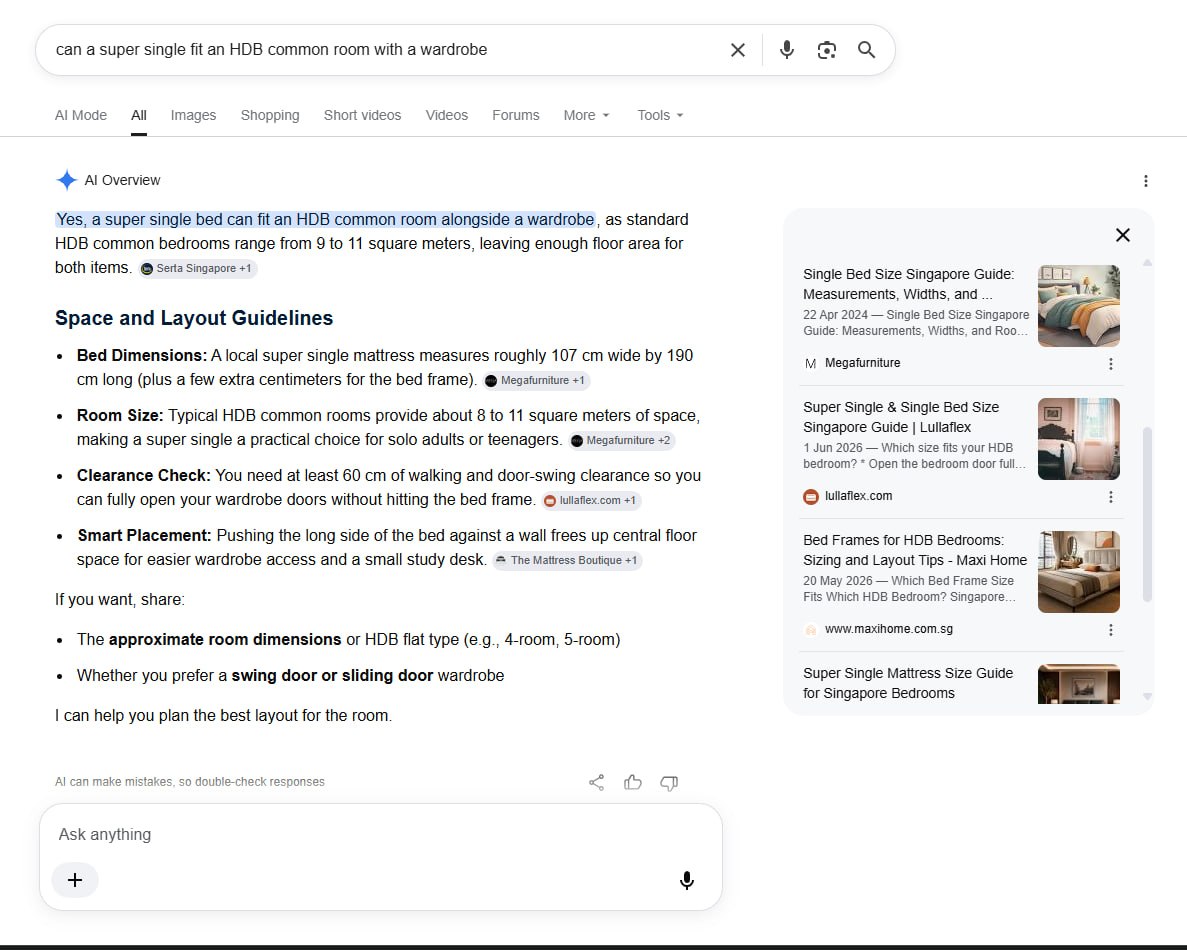
Same reason as ChatGPT. The Lullaflex page had the specific number, 60cm of door-swing clearance, stated plainly. Most furniture sites talk about "spacious layouts" without ever committing to a figure an AI can lift into an answer.
And it ranked on page one
Same query, normal blue links this time. Lullaflex was on page one, a few spots down but on the first page, sitting next to furniture retailers that have been around for years.
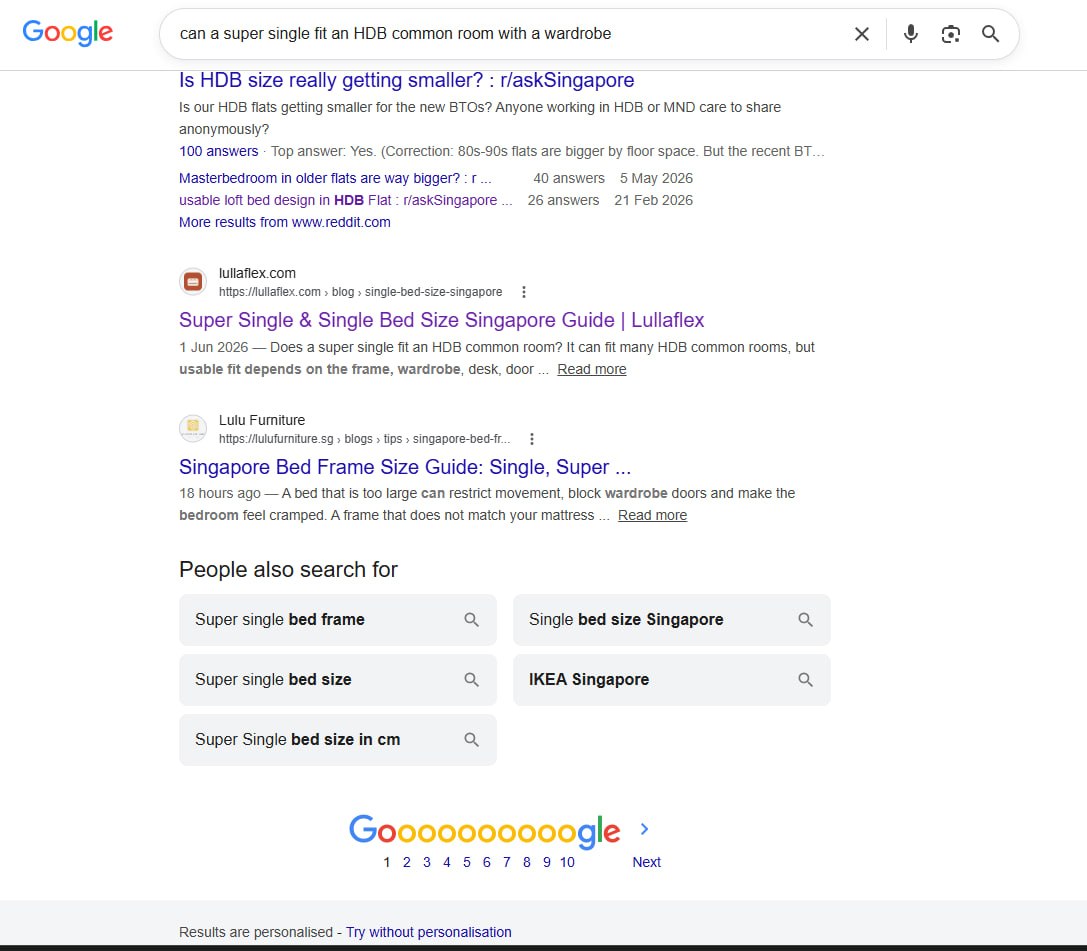
For a site this young with this little authority, page one for anything was more than we expected.
The part we had to be honest about
This is where most "we got cited by AI" posts stop. We did not, because one of those three results fell apart the moment we checked it properly.
The Google AI Overview citation was captured on a browser that had been opening lullaflex.com constantly all through the build. That is a personalised session. Google leans on your own history, so if you keep visiting a site, it is far more likely to show and cite that site back to you.
So we took personalisation out of it. Logged out, Singapore location, clean session. Then we ran eight real questions people ask about single and super single beds and looked at who the AI Overview actually cited.
| What we checked (clean, logged-out session) | Result |
|---|---|
| The 8 bed-size questions we tested | AI Overview fired on all 8 |
| Times it cited Lullaflex | 0 of 8 |
| Who it cited instead | Established furniture sites, one appeared in all 8 |
Zero out of eight. In a neutral session, Google's AI Overview cited the big furniture sites every time and never cited Lullaflex. The result that looked so exciting on our own screen was mostly Google showing us our own reflection.
The ChatGPT citation and the page-one ranking held up. The Google AI Overview citation did not. Two real, one personalised. That gap matters, because if you build a strategy on a personalised result, you are optimising for an audience of one: yourself.
What an on-page score cannot prove
The site scored 97 on rankr's technical checker, while the published Singapore SME benchmark had a median of 92 across 71 scanned sites. That result showed clean page hygiene: titles, schema, internal links and structure.
It did not measure authority, demand or whether an AI system would retrieve the page. A new site can pass every on-page check and still rank poorly. The separate Lullaflex technical case study explains that distinction. Abhishek, who built the checker, wrote up the engineering side of the same gap in his note on this citation, including what it changed about what rankr measures.
What actually earned the citations
Take out the personalised result and a clear pattern is left.
In ChatGPT, Lullaflex was only cited on specific, scenario-shaped questions. "Can a super single fit an HDB room with a wardrobe." "Can a single bedsheet fit a super single." Broad head terms like "super single bed size" moved more slowly in organic search: in July 2026 the site averaged position 33.4 for that search in Search Console, where established sites own page one.
On those specific questions, the winning pages did one thing well. They answered with a concrete fact the competition stated vaguely or left out entirely. 60cm of clearance. The exact centimetre gap between a single and a super single sheet. Real numbers an AI can quote word for word.
That is the whole move. Not more content, not another generic guide. Specific questions, answered with facts nobody else bothered to write down.
What this means if you run a small business
You do not need years of backlinks to start appearing in AI answers. That is the genuinely new thing here. For ordinary Google ranking, authority is still king and a young site waits its turn. For AI citation, being the page with the clearest, most specific answer counts for a lot, even at low authority.
The catch is that you still need enough trust to be in the running. Lullaflex ranked near the bottom of page one on its best queries, and that was enough to get pulled into ChatGPT. It was not enough to beat the incumbents inside Google's own AI Overview. So the honest version is this: specific, citable facts get you into AI answers surprisingly early, and authority still decides how often and how reliably.
For a Singapore SME the practical order is simple. Find the specific questions your customers actually ask. Answer each one with a real, checkable fact on a clean page. Then build the authority that turns "sometimes cited" into "usually cited." That is the work rankr does: specific answers first, followed by the authority needed to make visibility repeatable.
How do you get your own business cited by ChatGPT?
These are the steps we now run for every client, in this order.
- Let Bing see your site. ChatGPT's search draws on outside search engines, and Bing is one of them. Add your site in Bing Webmaster Tools, which can import it from Google Search Console in a couple of clicks, and submit your sitemap. It takes about 10 minutes and costs nothing.
- Fill in your Google Business Profile. Correct categories, opening hours, address, phone, services and photos, plus a steady flow of real reviews. Google's AI answers lean on it for anything local.
- Turn your customers' questions into headings. People ask AI in full sentences, like "how much does an aircon chemical wash cost in Singapore?". Make that the heading and answer it in the first line underneath with a real number, the way the Lullaflex pages gave exact centimetres. A study of AI answer engines accepted at KDD 2024 found that edits like adding statistics and citing sources can lift a page's visibility in their answers by up to 40% (GEO: Generative Engine Optimization).
- Get named on the pages ChatGPT reads. When we asked ChatGPT who to hire for 11 kinds of Singapore businesses, 57% of the links in its answers went to business websites, 19% to government sites, 10% to directories and review sites and 9% to "best of" lists (our study, 3,912 links in 330 answers). Your own website comes first, and accurate listings come next.
- Check it the way a customer would. Ask ChatGPT the questions your customers ask, 10 times each, and count how often it names you. One answer tells you very little, because ChatGPT's first pick changes from one answer to the next.
Frequently asked questions
Do you need domain authority to get cited by ChatGPT?
Not much. Our first client, Lullaflex, started at a domain rating of 0 with no backlinks, and ChatGPT was citing it within two months of us building the site. ChatGPT pulled the page in because it carried concrete, extractable facts that matched the question, not because the domain was strong. Authority still helps, but it is far less of a gate for AI citation than it is for normal Google ranking.
Does Google's AI Overview use domain authority?
In our testing, much more than ChatGPT does. In a clean logged-out session, Google's AI Overview cited established furniture sites on all eight bed-size questions we ran and never cited our first client's low-authority site. The one time it did cite Lullaflex was in a personalised session, which is not a reliable signal. What the box does pull from is in our guide to Google AI Overviews for Singapore businesses.
Why did ChatGPT cite a brand-new mattress site?
Because the page answered the exact question with specific facts: seven-zone latex, a cool-touch cover, no thick memory foam, designed for Singapore humidity. ChatGPT sets its own criteria for a query and then looks for pages that match them cleanly. A precise, factual page beats a generic one even when the generic one sits on a stronger domain.
How does a small business get cited by ChatGPT?
Target specific, scenario-based questions your customers ask, not broad head terms. Answer each with a concrete, checkable fact that competitors state vaguely or leave out. Put it on a clean, well-structured page. You will not beat established brands on the broad terms early, but you can win the specific questions surprisingly fast.
Is being cited once actually worth anything?
On its own, one citation is a data point, not a strategy. It tells you the page can be retrieved. What matters is whether you can reproduce it across many real questions and turn that attention into enquiries. That is the difference between a lucky screenshot and a repeatable channel.
Does ranking on Google get you cited by ChatGPT?
Not on its own. In our study, fewer than 1 in 10 of the websites ChatGPT linked to were on Google's first page for that trade's main search. Ahrefs found the same at page level: only 8% of the pages ChatGPT cited were in Google's top 10 (Ahrefs). ChatGPT still has to be able to read your site, but it picks from far more pages than Google's top 10.
How long does it take to get cited by ChatGPT?
For our first client it took two months, starting from a site with nothing on it. The citations came on specific questions first, and broad searches like "super single bed size" moved more slowly.
We post findings like this on LinkedIn. Follow rankrHQ


Want this done on your site? You work with the founders, Abhishek and Abel. Get a free SEO audit or see pricing.