Our First Client's Bedroom Planner Appeared Next to a Google AI Overview
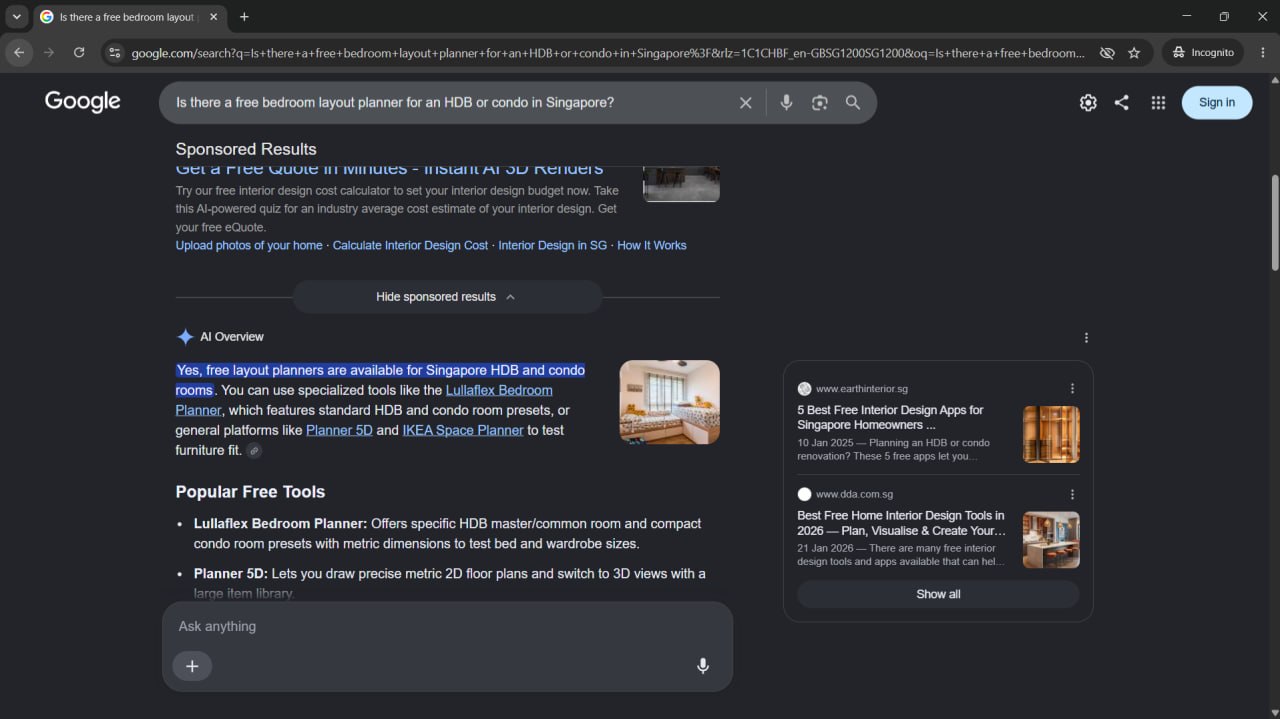
A single clean-session search put Lullaflex's free Bedroom Layout Planner next to a Google AI Overview. Here is what the screenshot proves, what changed beforehand and what we still cannot claim.
In short
- On 12 August 2026, an incognito Google search for a small-Singapore-bedroom query showed the Lullaflex Bedroom Layout Planner beside an AI Overview.
- The planner was a real interactive tool with Singapore room guidance, internal links, metadata and structured data, not a thin article built for one phrase.
- One screenshot proves one appearance. It does not prove endorsement, repeatability, traffic or that one SEO edit caused the result.
The result, without the victory lap
On 12 August 2026, rankr searched Google in an incognito Chrome window for:
what size mattress fits a small singapore bedroom?
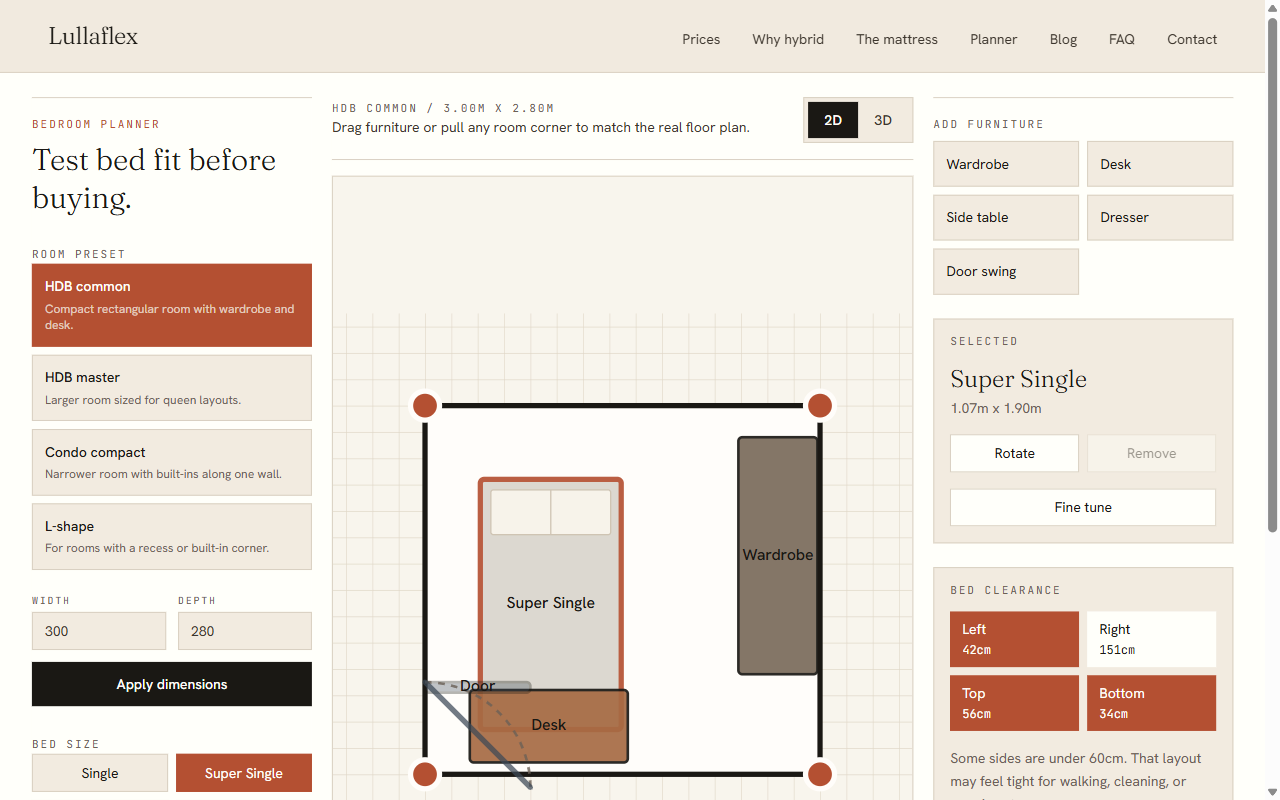
Captured 12 August 2026 in an incognito Chrome session. One observation, not a repeatability claim.
Google returned an AI Overview about fitting beds into small Singapore bedrooms. In the same result view, it displayed the Lullaflex Bedroom Layout Planner, a free tool for testing bed sizes, wardrobes, desks, door swings and walking clearance in HDB and condo rooms.
That is a real visibility win. It is not a Google endorsement. Google's documentation calls the URLs shown in AI features supporting links. A link helps a user explore the answer; it does not mean Google recommends the company or certifies the tool.
The screenshot is also one observation, not a stable ranking report. Incognito removes some account history, but results can still vary by location, language, device, query wording and time.
What the screenshot proves
It proves four things.
- Google showed an AI Overview for the query in that session.
- The Lullaflex planner was visible beside that AI Overview.
- The page was crawlable, indexed and relevant enough to be shown for a Singapore room-fit question.
- A useful tool from a low-authority site can earn AI-search visibility for a narrow problem.
It does not prove that the page will appear for every person, every device or every repeat of the query. It does not prove a click. It does not show that Google recommends Lullaflex. And it does not isolate one edit as the cause.
What existed before the appearance
The tool did not begin as a blog paragraph with a keyword inserted into it. It began as a product.
Lullaflex launched the Bedroom Layout Planner on 4 July 2026. It lets a visitor enter a room size, move furniture at scale, switch between 2D and 3D, and check clearance around a bed. The page had a dedicated title, description, canonical URL, social preview, sitemap entry and WebApplication structured data.
On 29 July, the planner page received a substantial content expansion. The page added visible guidance on:
- measuring walls, windows, columns, sockets and door swings;
- using the outside dimensions of the bed frame rather than the mattress alone;
- leaving space to walk, clean and open storage;
- checking lifts, corridors and bedroom doorways before delivery;
- comparing single, super-single and HDB room-fit guides.
Those changes matter because the query was not simply asking for a mattress product. It was asking whether a mattress would fit a small Singapore bedroom. The page answered that job directly and gave the user a tool to test it.
On 5 August, the site's product catalogue and content architecture were expanded. Product pages, buying guides and the planner were linked into clearer paths. A functional 3D issue in the planner was also fixed that day.
Later updates on 9 and 10 August added broader homepage, schema, product-evidence and cooling-content improvements. Those happened too close to, or after, the screenshot to support a clean causal claim about this planner result.
What we changed across Lullaflex
This was a wider SEO and site architecture rollout, not a metadata-only adjustment.
The work included:
- new product and collection pages with prices, variants, images and Product schema;
- clearer separation between informational guides and transactional product pages;
- consolidation of overlapping cooling and mattress-size topics;
- direct answers for size queries such as 91 × 190 cm and 107 × 190 cm;
- original HDB room-layout diagrams and branded article covers;
- internal links between guides, products, warranty information and the planner;
- metadata aligned with the intent each page served;
- breadcrumb, local business, language and sitemap corrections;
- comparison tables, cited sources and explicit evidence limits;
- balanced product comparisons grounded in verifiable specifications.
Metadata was one part of the work. The larger change was making each page more useful, better connected and easier for search systems to understand.
The useful lesson: match the query to the right page type
The query asked someone to solve a room-fit problem. A tool was the right page type.
That distinction matters:
| Searcher job | Best starting page |
|---|---|
| Do or calculate something | Tool |
| Compare a real offer, price or provider | Product or service page |
| Understand a problem | Informational guide |
| Decide whether a method worked | Case study |
This is not a Google rule. It is a useful information-architecture test: build the page that completes the user's job instead of forcing every query into a blog template.
For Lullaflex, the planner completed the job. The article layer around it supplied the measurements, room-fit advice and internal paths that made the tool understandable.
Why we are not claiming causality
Several changes were made across the site in the weeks before the screenshot. We do not have a controlled before-and-after test where one variable changed and everything else stayed still. Google can also take days or weeks to recrawl changes, and AI feature links can vary between runs.
So the honest claim is:
After Lullaflex shipped a useful bedroom-planning tool, expanded the page with Singapore room-fit guidance and connected it to the site's size and product content, the planner appeared beside a Google AI Overview for one incognito Singapore-bedroom query.
The dishonest claim would be:
We changed the metadata and Google recommended Lullaflex's tool.
The screenshot does not support that sentence.
How to test whether the result repeats
A real follow-up would pre-register a small query set before checking results. For this topic, that could include:
- what size mattress fits a small singapore bedroom?
- can a queen bed fit in an hdb bedroom?
- single or super single for a small room singapore
- how much clearance around a bed?
- bedroom layout planner singapore
For each check, record the exact query, date, Singapore location, language, device, account state, whether an AI Overview appeared, whether Lullaflex appeared, and the URL shown. Repeat on separate dates. One screenshot becomes a case study. Repeated observations become a trend.
Google currently folds AI Overview and AI Mode traffic into Search Console's ordinary Web reporting. It does not provide a dedicated citation or share-of-voice metric. Search Console can still measure the page's queries, impressions, clicks and average position. Analytics is needed for conversions and engagement.
The practical lesson
Useful free tools can create a stronger search asset than another generic article when the query asks the user to complete a task.
A useful tool still needs promotion, relevant mentions and earned links to compete on broader queries. Functionality alone does not create authority.
The practical sequence is:
- Map the query to the job.
- Choose the page type that completes that job.
- Add original information or functionality competitors do not have.
- Connect the page to relevant guides, products and service pages.
- Make the claim easy to verify and the limits explicit.
- Measure queries and pages in Search Console over time.
That is less exciting than an AI Overview hack. It is also what the evidence supports.
Sources and reproducibility
- Google: AI features and your website
- Google: How Search works
- Lullaflex Bedroom Layout Planner
- Lullaflex mattress size guide
- Lullaflex cooling mattress guide
Frequently asked questions
Did Google recommend Lullaflex?
No. The safe claim is that the Lullaflex Bedroom Layout Planner appeared beside a Google AI Overview for one query. A supporting or adjacent link is visibility, not an endorsement.
Does one screenshot prove the result is repeatable?
No. Search results can vary by location, language, device, query and date. The same query should be checked repeatedly under recorded conditions before reporting a trend.
Did metadata cause the result?
We cannot isolate metadata as the cause. The planner was a working product, the page added substantial room-planning guidance, the site added product and content architecture, and several changes overlapped in time.
Do websites need special AI markup for Google AI Overviews?
No. Google says standard SEO practices remain relevant and no special AI files or Schema.org markup are required.
Does an AI Overview appearance prove traffic?
No. A screenshot proves appearance in that session. It does not prove a click or conversion.
We post findings like this on LinkedIn. Follow rankrHQ


Want this done on your site? You work with the founders, Abhishek and Abel. Get a free SEO audit or see pricing.