Where Does ChatGPT Get Its Information? We Sorted 3,912 Links
We asked ChatGPT and Perplexity who to hire in 11 Singapore trades and sorted every link in their answers. They read very different parts of the web.
In short
- Asked who to hire in 11 Singapore trades, ChatGPT sent 57 of every 100 links to the businesses' own websites.
- Perplexity sent 42 of every 100 links to 'best of' lists, and 1,206 of the 1,311 lists it cited were written by publishers, not by the businesses on them.
- Only 6 in 100 of the websites ChatGPT linked to were on Google's first page, so ranking and being recommended are mostly separate lists.
- For ChatGPT, work on your own website. For Perplexity, get onto the lists other people write.
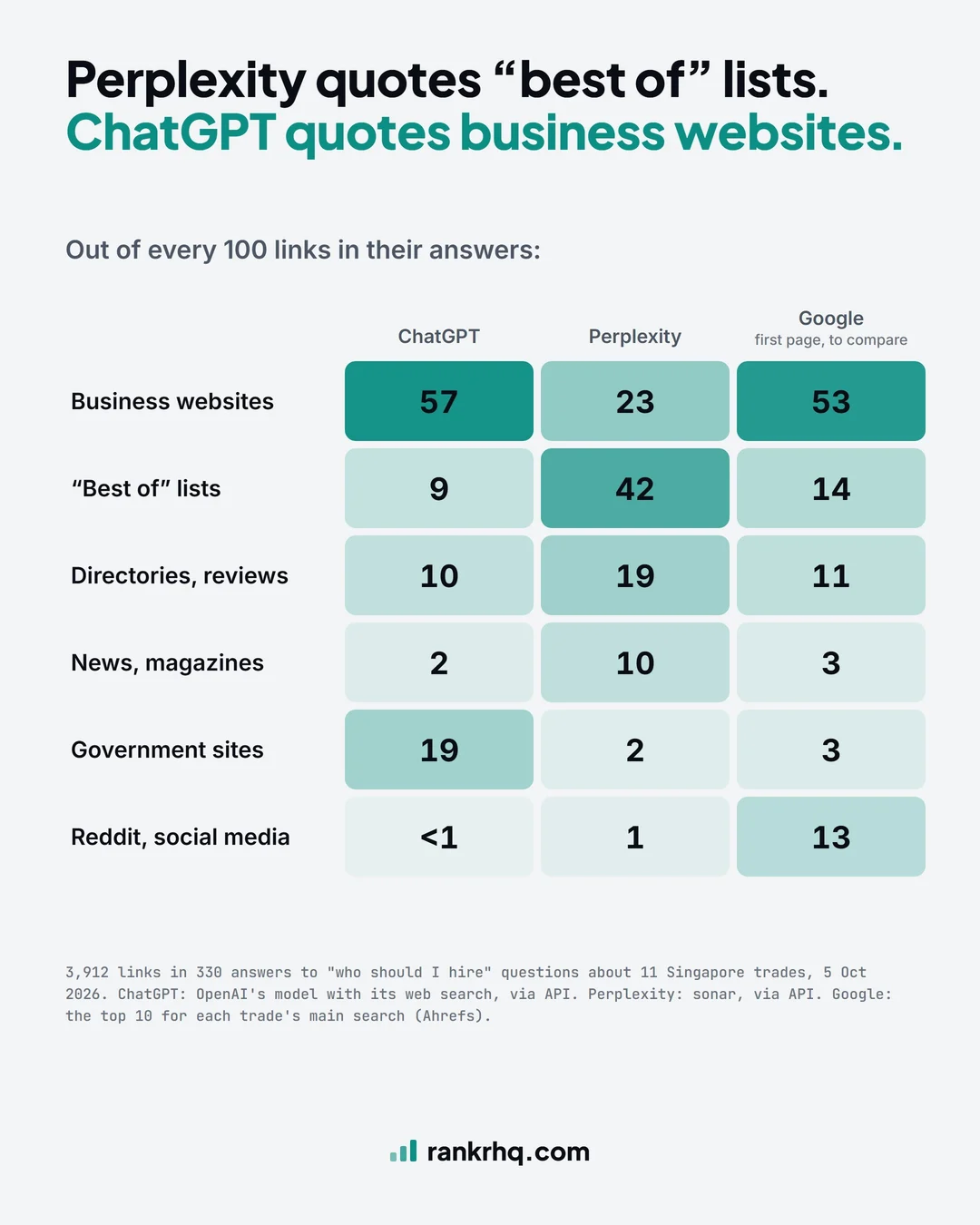
When ChatGPT recommends a Singapore business, most of its links go to businesses' own websites: 57 of every 100 in our study. Perplexity answers the same questions mostly from "best of" lists: 42 of every 100 of its links. We asked both assistants 55 "who should I hire" questions about 11 Singapore trades on 5 October 2026 and sorted all 3,912 links in their 330 answers.
That gap decides where the work goes. For ChatGPT it is your own website. For Perplexity it is the lists other people write about your trade.
Where does ChatGPT get its information?
For these questions ChatGPT searched the web and linked a median of 5 sources per answer. Of its 803 links:
| Source type | Share of links | Links |
|---|---|---|
| Websites of businesses in the trade | 57% | 460 |
| Government sites | 19% | 150 |
| Directories and review sites | 10% | 83 |
| "Best X in Singapore" lists | 9% | 73 |
| News and magazines | 2% | 20 |
| Forums and social media | under 0.5% | 2 |
| Other | 2% | 15 |
The government links were most often the Ministry of Manpower and the Ministry of Health. Reddit and social media barely appeared: 2 links in 803.
Where does Perplexity get its information?
Perplexity cited far more sources, a median of 19 per answer, and leaned on lists. Of its 3,109 links:
| Source type | Share of links | Links |
|---|---|---|
| "Best X in Singapore" lists | 42% | 1,311 |
| Websites of businesses in the trade | 23% | 713 |
| Directories and review sites | 19% | 606 |
| News and magazines | 10% | 326 |
| Government sites | 2% | 57 |
| Forums and social media | 1% | 42 |
| Other | 2% | 54 |
Almost all of those lists were published by someone other than the businesses on them: 1,206 of the 1,311, mostly news sites and magazines (768) and directories and review sites (369). Only 105 were a business's own "best of" page. One law firm's "best lawyers in Singapore" page was a source in all 10 Perplexity answers to "can you recommend a good lawyer in Singapore?", and not one answer named the firm.
How does that compare with Google's first page?
Google's top 10 for each trade's main search held 94 results: 53% business websites, 14% lists, 13% forums and social media, and 11% directories and review sites. The mix looks closer to ChatGPT's, but the websites themselves were mostly different. Over ten rounds of the same questions, 6 in 100 of the websites ChatGPT linked to were on Google's first page for that trade's main search (39 of 601), and 10 in 100 for Perplexity (46 of 459).
Ranking on Google and being linked by an assistant are mostly two separate lists.
Does each assistant give the same answer every time?
Perplexity mostly does. Across its questions, its most common first pick came first in a median of 9 of 10 answers. ChatGPT's came first in a median of 5 of 10, and its first pick changed at least once for 50 of 54 questions across ten asks. One ChatGPT answer tells you little about where you stand.
What should a Singapore business do for each?
- For ChatGPT, work on your own website. Put your prices, the areas you serve and plain answers to the questions customers ask in the page text, where a crawler can read them.
- For Perplexity, get onto the lists other people write. Find the "best X in Singapore" pages it cites for your trade and ask the writer to add you, and get listed on the directories and review sites in its sources.
- For both, check the sources. Ask the question your customers ask ten times, open the sources under each answer, and count which are your pages and which are lists you are not on. The ten-minute check on our study page walks through it.
How we counted
Both assistants were asked through their APIs on 5 October 2026: ChatGPT is OpenAI's model with its web search, and Perplexity is its sonar model. That is 55 questions, five for each of 11 trades, asked three times each, giving 330 answers and 3,912 links. Every link was labelled by type, and the same rules were applied to Google Singapore's top 10 for each trade's main search (Ahrefs, August to October 2026). The answers, labels and code are on the study page.
Frequently asked questions
Where does ChatGPT get its information when it recommends a business?
From a web search it runs when you ask. In our study of 330 answers about Singapore trades, 57 of every 100 links in ChatGPT's answers went to the websites of businesses in the trade, 19 to government sites and 10 to directories and review sites.
Where does Perplexity get its information?
Mostly from "best X in Singapore" lists: 42 of every 100 links in our study, then business websites (23) and directories and review sites (19). Perplexity cited a median of 19 sources per answer, against 5 for ChatGPT.
Does ranking first on Google get you into ChatGPT's answer?
Rarely on its own. Over ten rounds, 6 in 100 of the websites ChatGPT linked to were on Google's first page for that trade's main search.
Does writing my own "best of" list help?
Not much on this evidence. Of the 1,311 lists Perplexity cited, 105 were a business's own page, and the clearest case, a law firm's "best lawyers in Singapore" page, was a source in 10 of 10 answers without the firm being named once.
We post findings like this on LinkedIn. Follow rankrHQ


Want this done on your site? You work with the founders, Abhishek and Abel. Get a free SEO audit or see pricing.