
SEO Results in Singapore (2026): How Long They Take
SEO results come in four stages, and on our first client's brand-new site the first one took days while the climb up Google took months. This is what each stage looked like, month by month, and how to check each one on your own site.
- 01Our first client's site launched at the end of May 2026 on a new domain with no backlinks. From June to September 2026 its monthly Google impressions went from 1,091 to 9,958, its clicks from 1 to 64, and its average position from 49.1 to 18.2.
- 02Indexing took days: Search Console recorded the first impressions on 1 June, three days after the domain was registered. Moving up took months, and the first pages to climb were guides that each answer one narrow question.
- 03Seven of the eight product pages that appeared in Google in September still averaged between position 34 and 52, and Search Console cannot show whether a click became an enquiry. Count enquiries through your enquiry form in Google Analytics and by asking every caller how they found you.
- 04In June 2025, Google's page on hiring an SEO said results typically take four months to a year. The version updated on 5 June 2026 gives no timeframe and tells you to ask the SEO what results to expect, and when.
On a brand-new website, Google can start showing your pages within days, but moving them up for the searches that bring customers takes months. Our first client's site in Singapore appeared in Google three days after its domain was registered, and by September, its fourth month, its average position had climbed from 49.1 to 18.2, from page five to page two, while seven of the eight product pages that appeared in Google that month were still on pages four to six. SEO results come in four stages: Google indexes your pages, shows them in searches, moves them up for the searches your customers type, and then those visits start turning into enquiries. You can check each one on your own site in Google Search Console.
How long does it take to see SEO results on a new website?
Google's own pages give a range instead of a date. Its SEO Starter Guide says "Some changes might take effect in a few hours, others could take several months", and suggests waiting a few weeks before judging whether a change helped. Its page Do you need an SEO? said in June 2025 that owners should expect results "typically from four months to a year from the time you begin making changes" (archived copy). The version updated on 5 June 2026 gives no timeframe. It tells you to ask the SEO "What kind of results do you expect to see, and in what timeframe? How do you measure your success?" and warns that "No one can guarantee a #1 ranking on Google."
Lullaflex, our first client, sells mattresses in Singapore. The site launched at the end of May 2026 on a domain registered on 29 May (registry record), so it started with no history and no backlinks. We built the site from scratch and kept adding guides that each answer one customer question, and 27 of those guides appeared in Google searches in September. Search Console's data for the domain starts on 30 May, and Google recorded the site's first two impressions on 1 June. These are the four full months since then, pulled from the domain's Search Console property on 3 October 2026, when the last day of September was still provisional.
| Month (2026) | Pages with impressions | Impressions | Clicks | Average position |
|---|---|---|---|---|
| June | 5 | 1,091 | 1 | 49.1 |
| July | 21 | 3,992 | 7 | 36.4 |
| August | 40 | 8,680 | 29 | 31.7 |
| September | 55 | 9,958 | 64 | 18.2 |
Pages with impressions counts the pages that appeared in at least one Google search that month. An impression is one appearance in someone's results, clicked or not, and average position is where the site appeared, averaged across all of those searches. Position 49 is around page five of Google. Position 18 is on page two.
The totals overstate how fast any one page moved. Part of the rise is Google discovering a site that did not exist until the end of May. The number of pages with impressions went from 5 to 55, mostly as new pages went live, and each new page appears in its own set of searches, so total impressions grow even when no single page moves. Google also changed its ranking systems during those months: its May 2026 core update started on 21 May and took almost 12 days to roll out, so it was still running in the site's first days, and spam updates started on 24 June, 18 August and 24 September, according to the Google Search Status Dashboard.
The totals also hide which pages moved. Most of the climb came from blog guides that each answer one narrow question, such as single bed sizes or bed sheet sizes in Singapore. In September, the 27 guides that appeared in Google averaged around position 12 and brought in 45 of the 64 clicks. Eight of its product pages appeared in Google that month. Seven of them, six mattress pages and one pillow page, still averaged between position 34 and 52, and the eight together brought in 3 clicks.
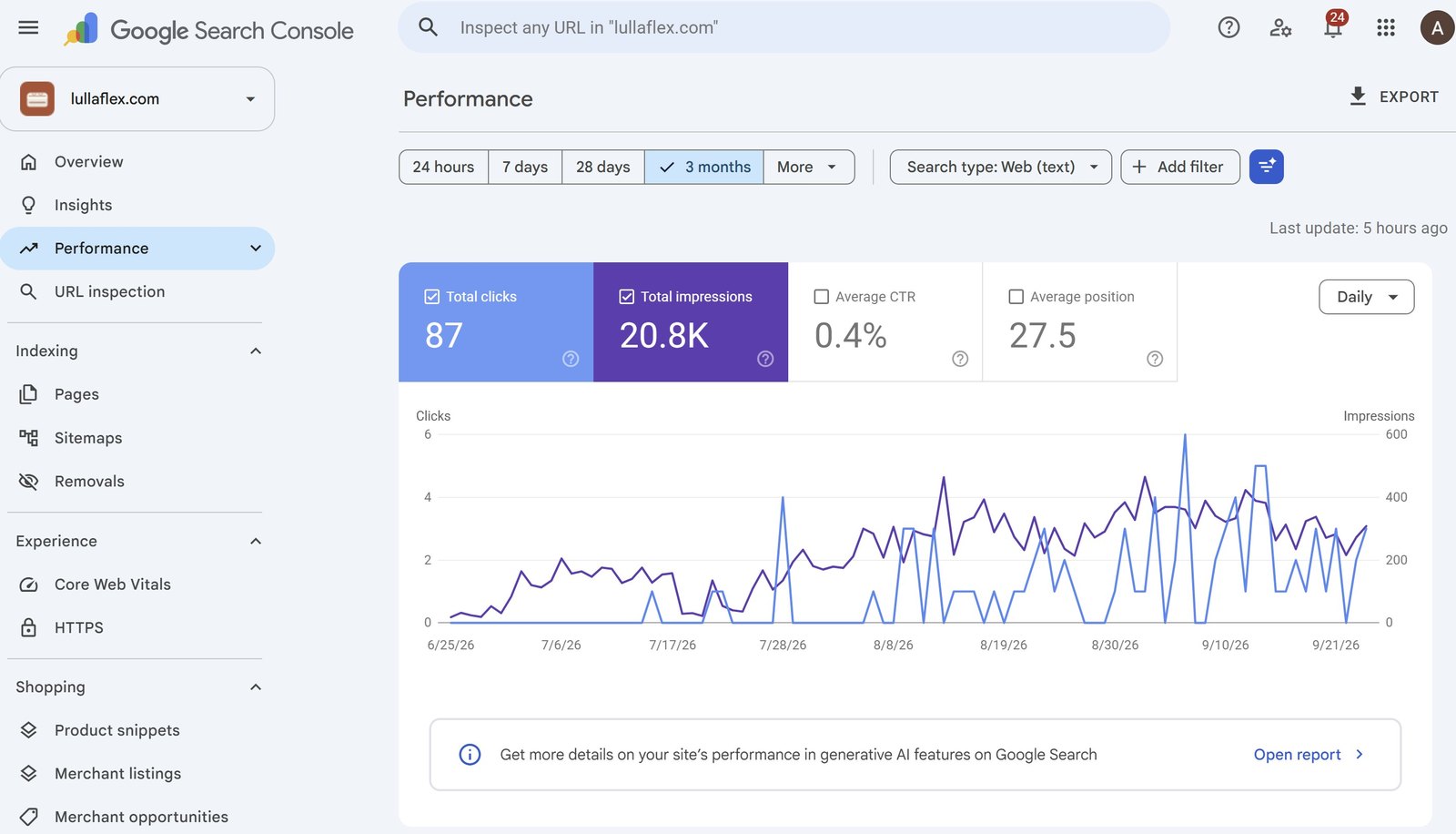
The same Search Console property over a different window, 25 June to 24 September 2026: 87 clicks, 20.8 thousand impressions and an average position of 27.5. That window cuts across calendar months, so its totals do not match the table.
Stage 1: has Google indexed your pages?
A page can appear in Google only after Google has crawled it and added it to its index. For our first client that took days, from a domain registered on 29 May to the first impressions on 1 June. Google's own range is wider. Its guide to asking Google to recrawl your URLs says crawling "can take anywhere from a few days to a few weeks", and that requesting a recrawl many times for the same URL "won't get it crawled any faster".
To check one page, paste its full address into the inspection bar at the top of Search Console. "URL is on Google" means the page is indexed and can appear in results, although Google says that does not mean it will. For the whole site, open Indexing, then Pages, and read the table of reasons pages are not indexed. Two of those reasons sound alike and mean different things, according to Google's Page indexing report help. "Discovered, currently not indexed" means Google found the URL but has not crawled it yet, typically because crawling it then "was expected to overload the site". "Crawled, currently not indexed" means Google crawled the page and left it out for now. Google says it "may or may not be indexed in the future" and that there is no need to resubmit it.
Google's SEO starter guide says it "primarily finds pages through links from other pages it already crawled", so link every new page from at least one page that is already indexed, such as your homepage or a service page, and keep your sitemap current. If a page stays out of the index and you want to rule out a technical cause, our free SEO visibility checker shows whether its title, description, main heading and text are in the HTML a crawler receives.
Stage 2: is your website showing up in Google searches?
The first sign that indexing worked is impressions, which Search Console shows under Performance, then Search results. Google generally counts an impression whenever a link to your site is on the page of results someone is viewing, even if they never scroll down to it, according to its guide to impressions, position and clicks.
June was this stage for our first client. Google showed 5 of its pages 1,091 times, and the site got 1 click. One guide, about queen size mattresses, accounted for 915 impressions at an average position of 51, which is page six. Judged by clicks, June looked like nothing was happening, but Google was already showing a site registered in late May for searches like "queen size mattress singapore".
Stage 3: are your pages moving up for the searches that matter?
This is where most of the waiting happens. In Search Console, open Performance, tick Average position, switch to the Queries tab and set the date filter to compare the last 28 days with the 28 days before. Read the searches a customer would type one by one, because the site-wide average blends every search you appear in. Google's guide calls position "a complex metric that can be misleading if you don't understand the subtleties" and recommends watching how it changes over time.
For our first client, individual searches moved like this:
| Search | July | August | September |
|---|---|---|---|
| single bed size | 27.7 | 22.1 | 10.7 |
| super single bed size | 33.4 | 29.5 | 14.3 |
| super single bed size in cm | 54.4 | 23.6 | 9.4 |
| cooling mattress singapore | 37.7 | 36.8 | 27.2 |
| latex mattress singapore | no data | 50.2 | 50.8 |
Average position for each search by calendar month, counting every page of the site that appeared for it, from the same Search Console property. A single page's own position for the same search can differ. Search Console listed no data for "latex mattress singapore" in July.
None of the five searches in the table brought a click in any month, including the two that averaged around position 10 in September. Clicks followed the positions at page level. In September, the 22 pages that averaged position 10 or better brought in 46 of the site's 64 clicks, and the 11 pages that averaged worse than position 30 brought in 6.
The last row is the exception. "latex mattress singapore" is a search for something to buy, and the site sat around position 50 for it in both August and September while the bed size guides climbed to between position 9 and 15. A new domain has no history to lean on for searches like that, and our Lullaflex SEO case study covers why a clean technical setup was not enough on its own.
Narrow questions moved first outside Google too. Within two months of launch, ChatGPT named the site when someone asked for the best cooling mattress for hot weather, which we wrote up in how our first client got cited by ChatGPT.
Stage 4: is SEO bringing in enquiries?
Search Console stops at the click, which is why our table stops there too. It cannot tell you whether a visitor filled in your form, phoned you or bought anything, and neither can a ranking report.
Two ways to count this stage:
- Ask whoever manages your website to mark a sent enquiry form as a key event in Google Analytics 4. Then open Reports, Acquisition, Traffic acquisition. The report groups visits by where they came from, and the Organic Search row shows how many of those enquiries came from unpaid search results, according to Google's Traffic acquisition report help.
- Ask every caller and walk-in how they found you, and keep a tally by month. A phone call never appears in Search Console.
If clicks rise and enquiries do not, look at the page the visitors land on: whether it answers what they searched for and makes the next step obvious. For our first client, the pages that rank best are guides and the pages that sell are product pages, so the open question for the coming months is how many guide readers go on to a product page.
What should SEO show after one, three and six months?
These checks follow the stages in order and assume a site as new as our first client's. Searches that established sites already hold move slowest, as "latex mattress singapore" did for our first client.
- Month one: your homepage and main service pages show "URL is on Google", and Search Console shows impressions for at least some of them. In June, our first client's month one, 5 pages had impressions.
- Month three: impressions are higher than in month one, more pages appear in searches, and the searches you care about have moved up. In August, our first client's month three, 40 pages had impressions and the average position was 31.7.
- Month six: clicks are rising, you can count enquiries from organic search month by month, and some of your target searches have reached page one, position 10 or better. Our first client's guides got there by month four, while none of its product pages had.
If a month goes by and none of the four stages has moved, ask whoever does your SEO for the list of pages they changed that month, as links you can open. If they cannot send one, stop waiting. Our guide to what your SEO agency should show you every month covers what else that monthly report should include. If you need enquiries this month, a page that reaches page one in month five arrives too late, and SEO vs Google Ads for a Singapore business explains when paying per click is the better call. If you are comparing providers, SEO pricing in Singapore lists what published packages include and how long their contracts run.
Frequently asked questions
How long does SEO take in Singapore?
Expect months for the searches that bring customers. Google's SEO Starter Guide says some changes take effect in a few hours and "others could take several months", and its page on hiring an SEO said in 2025 that results typically take four months to a year. Our first client's new site, on a domain registered on 29 May 2026, appeared in Google within three days, and its average position moved from 49.1 in June to 18.2 in September, when it had 64 clicks from Google. Seven of the eight product pages that appeared in Google that month were still between position 34 and 52.
What are the 4 stages of SEO?
The four stages we track are indexing, impressions, rising positions and enquiries. A page has to be in Google's index before it can appear in searches, and it has to appear before it can move up. Search Console shows the first three stages. Enquiries need form tracking in Google Analytics or a "how did you find us?" question for callers.
How do I know if my SEO is working?
Check the four stages in order. In Search Console, see whether your key pages are indexed, whether impressions are rising month on month, and whether the average position for the searches your customers use is moving up. Then count enquiries from organic search in Google Analytics and from callers. If a stage has not moved for a month and nobody can show you what was changed, ask why.
Does SEO take less time for an older website?
It can skip ahead. If your key pages already show "URL is on Google" and already get impressions in Search Console, the first two stages are done, and what you are waiting for is stage 3: the searches the work targets moving up month by month. How fast that happens depends on which sites already hold those searches.
Why do I have impressions but no clicks?
Often because the pages appear too far down the results. In June 2026 our first client had 1,091 impressions and 1 click at an average position of 49.1, around page five. By September, the pages averaging position 10 or better brought in 46 of the site's 64 clicks.
We post findings like this on LinkedIn.