SEO guide · Chapter 6 of 6 · 5 min read
Measure and improve
Measure each stage separately: whether Google indexed the page, how often it is shown and where, how often it is clicked, whether AI answers mention you, and how many enquiries arrive. When a page underperforms, find the stage that failed before changing anything.
Updated
You leave with: A change log, a weekly check, and a way to diagnose a page that is not working.
How to compare fairly
Same window, same filters
Compare the last 28 days with the 28 days before, with the same country and device. Seasonal businesses should also compare with the same weeks last year.
A page and its searches together
Filter to the page, then open the Queries tab. A page earns traffic from many searches, so one keyword moving tells you little.
Look weekly, judge later
Positions move daily. We look every week and judge a change after four to eight weeks.
One change at a time
Change one meaningful thing per page where you can, so you know what caused what.
AI answers, monthly and recorded
Ask ChatGPT and Google the three to five questions a buyer asks, logged out or in a private window. Save the exact question, date, tool, whether you were logged in, and whether it repeated. For Google's own AI answers, clicks are counted in the normal Performance report (AI features), and since 31 August 2026 a separate report shows how often your pages appeared in them, as impressions only (Generative AI report). ChatGPT reports nothing to you, so you check it by hand. How we measure AI visibility.
Your change log
One row per change. It is the only way to know, months later, which change did what.
| Date | Page | Exact change | Why | Baseline | Review on | What happened | Confidence | Next |
|---|---|---|---|---|---|---|---|---|
| 8 Oct 2026 | /services/chemical-wash | Added Tampines prices and photos | Position 14, no area detail | 140 impr. / 14.2 / 2 clicks | 19 Nov 2026 | Low / medium / high | Keep / revise / revert / investigate |
When a page is not working
| Symptom | Check first | Possible fix |
|---|---|---|
| Not indexed | Access, canonical, robots.txt, noindex, what the live test receives | Fix the blocker, inspect again |
| Indexed, no impressions | Whether anyone searches for it, and whether another page of yours owns the task | Re-check the search and the ownership map |
| Impressions, weak position | How well it answers, its proof, and the strength of the sites above | Improve the answer and proof, or pick a narrower search |
| Good position, few clicks | Title, description, and what else sits on the results page | Rewrite how the result reads |
| Clicks, no enquiries | Offer fit, proof, doubts, the next step | Fix the page for buyers |
| An AI mention that does not repeat | Logged-in history, location, the tool, the date | Record it as one observation and re-test |
Pages fade, and the reason is usually outside the page
A page that used to perform can slowly lose clicks because competitors published better pages, the facts went out of date, or what searchers want changed (Ahrefs on content decay). For example, if a search that used to show service pages starts showing price comparisons, a service page with no prices will slide however well it is written. Re-read the live results before you rewrite.
Reading two numbers together helps. Impressions and click rate both falling usually means the page is losing ground. Impressions steady while click rate falls often means the results page changed around you, for example an AI answer now sits above it. Update a page when its content genuinely needs it; changing the date alone is something Google warns against (helpful content).
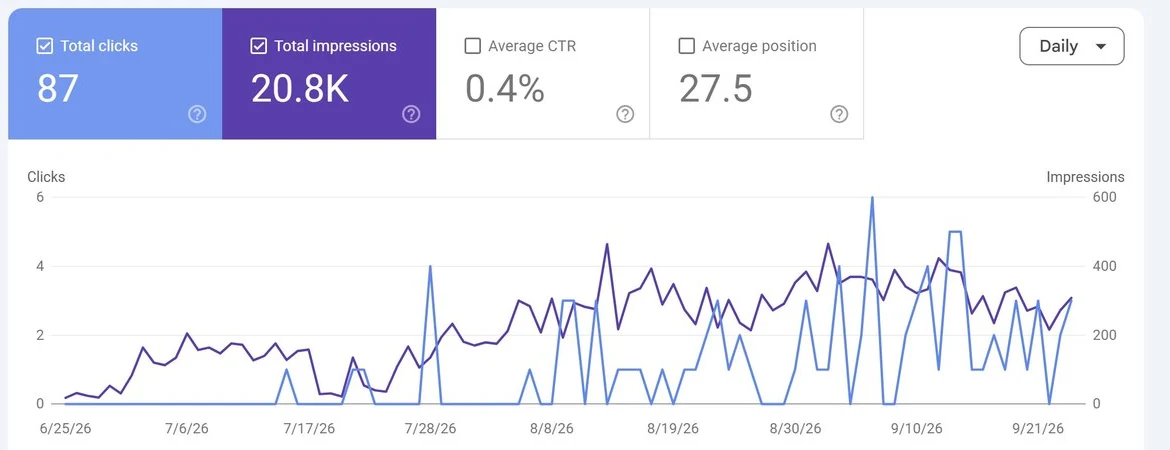
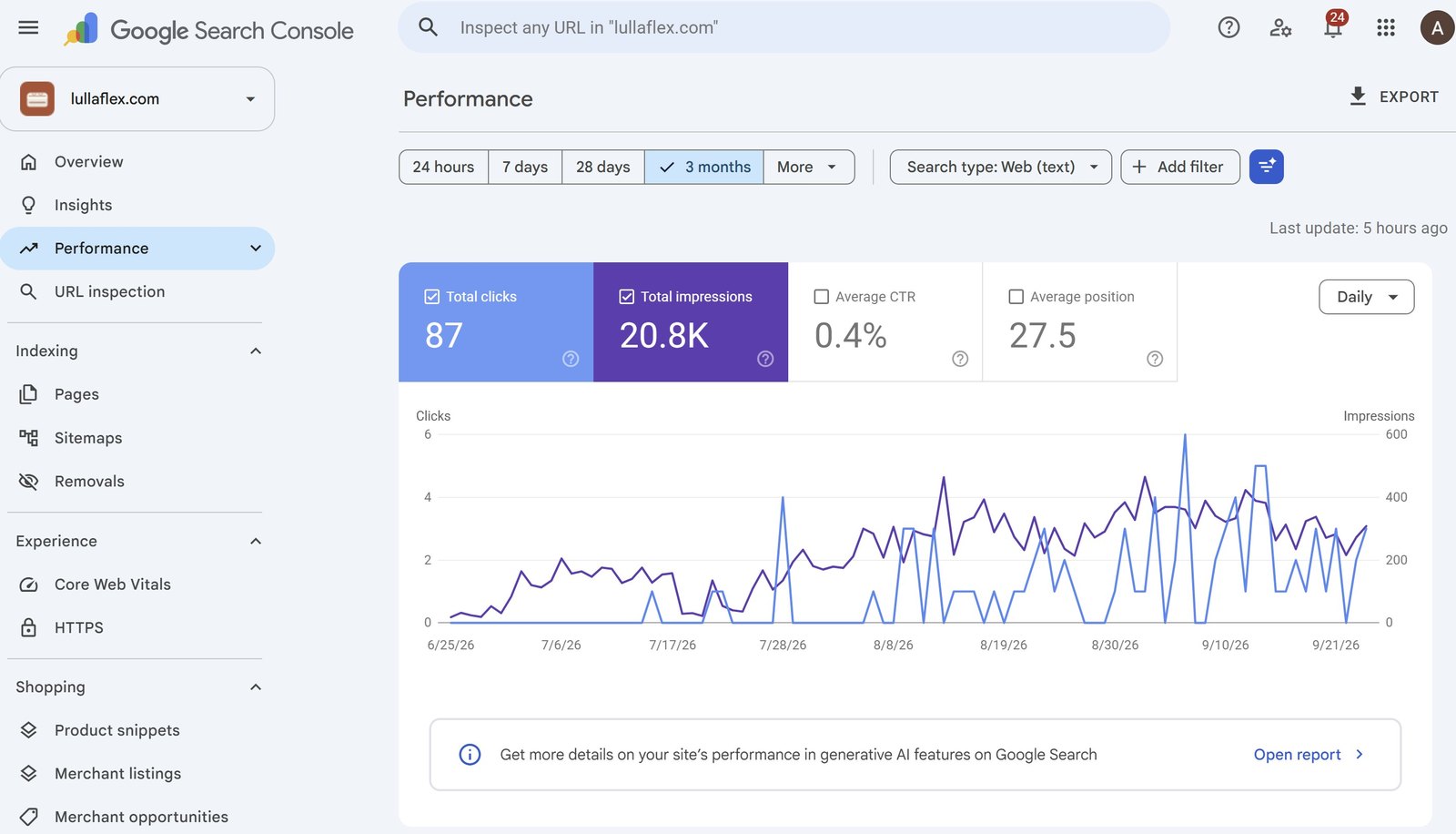
Worked example · lullaflex.com, Google Search Console, by month ·
Lullaflex: impressions came first, and one result did not hold up
Our first client, a Singapore mattress brand, had no website in May 2026. Monthly Google impressions went 1,091, 3,992, 8,680 and 9,958 from June to September; clicks went 1, 7, 29 and 64. We also saw Google's AI Overview cite a Lullaflex bed size guide, but that view was personalised: in a clean, logged-out session it appeared 0 times in 8 searches. We count it as a miss, and record every AI result with the session it came from. The full case study.
What this does not prove
- Several changes overlapped, so no single change can be credited with the result.
- One client in one category. Your timeline depends on your site, competitors and market.
Worked example · rankrhq.com, our experiment log ·
Waiting on purpose
On 24 August we improved three of our own pages, starting at positions 83.7, 70.5 and 85.5, and decided in advance to read the result at 90 days, around 22 November, with no promotion in between. We wrote the verdicts down first: any page reaching position 30 means on-page work still has room; all three staying above 70 means the site needs more links from other websites before more page edits will help.
What this does not prove
- The 90 days are not up. We will publish the result either way.
Common mistakes
- Rewriting a page after one bad week.
- Judging by one keyword instead of the page's whole group of searches.
- Changing five things at once.
- Reporting a single AI screenshot as a ranking.
- Celebrating traffic without checking enquiries.
Your 20-minute task
Start your change log with one row for the page from chapter 4, and set the review date four to eight weeks out.
Sources
- Google:Performance report: comparing dates
- Google:URL Inspection tool
- Google:AI features and your website
- Google:Generative AI performance report
- Ahrefs:Content decay
- rankr:Lullaflex case study
Ahrefs sells an SEO tool. We cite it for practical methods and check its numbers against the live results.