
How Singapore renovation and interior design firms get found online
Homeowners research on Qanvast, Google and now ChatGPT before they enquire. Here is how a Singapore renovation firm gets into those answers.
In short
- Homeowners research on Qanvast, RenoNation, Google and increasingly ChatGPT before they enquire.
- Your website wins the searches directories can't: real price ranges by flat type, HDB rules, and renovation timelines.
- The firm that states concrete Singapore-specific numbers gets the AI citation; brochure copy is invisible.
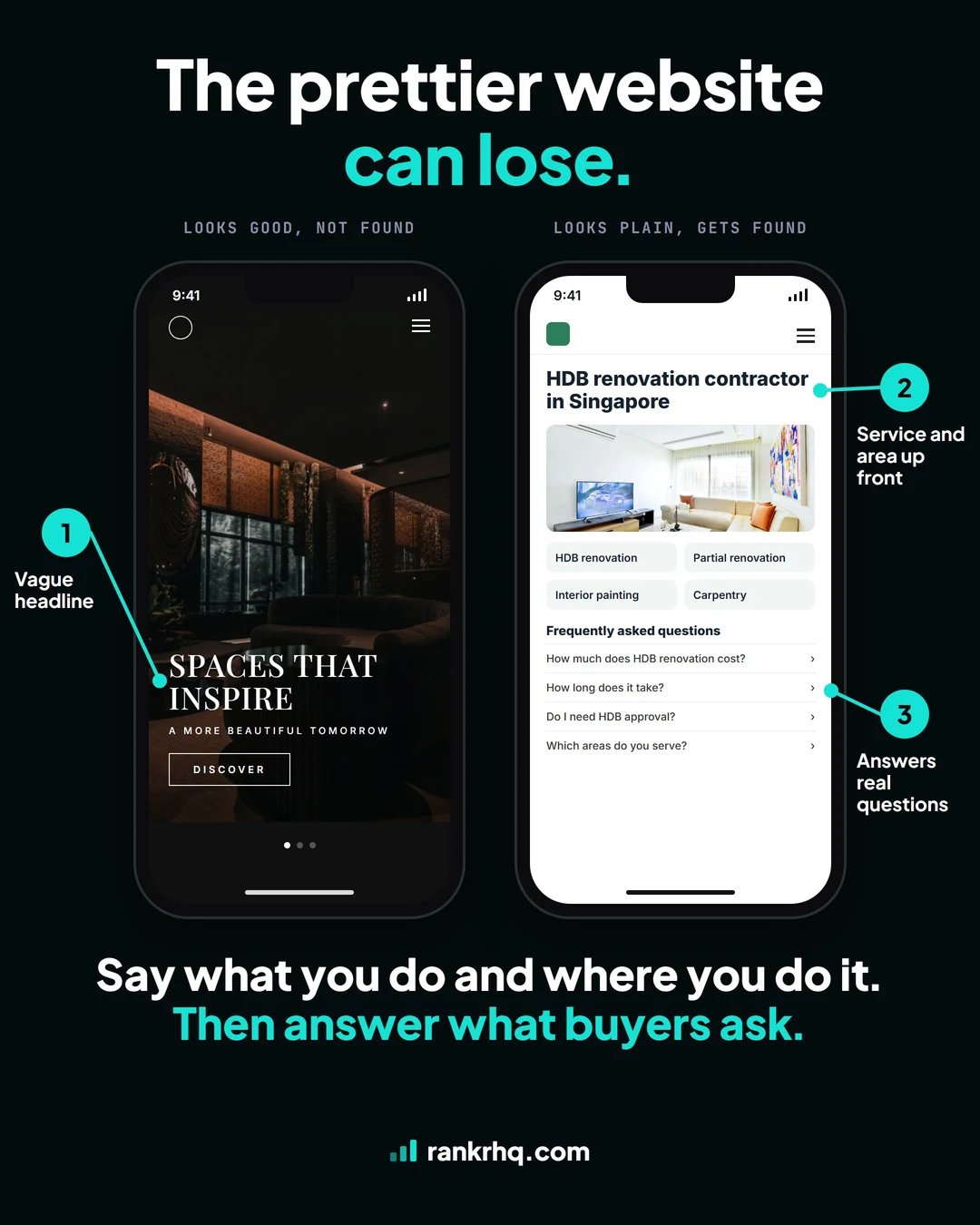
A Singapore renovation or interior design firm gets found online by being present where homeowners research (Qanvast, RenoNation, Hometrust, Google and now ChatGPT) and by publishing the pages those directories cannot: real price ranges by flat type, HDB rules and renovation timelines. A homeowner who has just collected BTO keys starts on the directories, then Googles "HDB renovation package price" and "best interior designer for 4-room BTO", and now also asks ChatGPT "how much does it cost to renovate a 4-room HDB in Singapore." If your firm only lives on the Qanvast directory, you are one of forty logos in a list.
The renovation and interior design market in Singapore is crowded with other local firms and the same handful of aggregators, which means clear, specific content can win without a giant budget.
Where do Singapore homeowners look for a renovation firm?
Renovation has its own set of directories and channels here, and a firm has to be present on all of them as well as on its own site:
- Qanvast, RenoNation, Hometrust are where the research starts. Claim and fill your profiles, keep real project photos current, and get reviews.
- Google, for the price and process searches the aggregators do not answer well: "HDB BTO renovation timeline," "can I hack this wall in an HDB flat," "renovation loan Singapore."
- Instagram and Pinterest for the design inspiration stage, which then sends people back to Google to check if you are legit.
- AI assistants, increasingly, for the scary questions: budgets, what is and is not allowed under HDB rules, whether a quote is reasonable.
Your own website's job is to win the searches the directories cannot: the specific, high-anxiety, high-intent questions.
What should a renovation firm publish on its website?
Homeowners search their fear, which is usually money and rules. Nobody searches "we create bespoke spaces that tell your story."
- Real price ranges by flat type. "4-room HDB renovation cost," "condo renovation package Singapore." You do not have to publish a fixed quote. Explain what a basic package covers, what pushes the number up (carpentry, hacking, overlay versus full), and a realistic range. The firm that is open about money wins the homeowner who is scared of it.
- The HDB rules content. What needs an HDB permit, what a licensed renovation contractor can and cannot do, the noise and timeline restrictions. It is useful, local, and almost nobody writes it clearly.
- Process and timeline. "How long does a BTO renovation take," "what happens after I pay the deposit." Anxiety lives in the unknown; the firm that removes it earns the enquiry.
How does a renovation firm get cited by ChatGPT?
When someone asks ChatGPT "how much to renovate a 4-room BTO in Singapore," it is not going to quote a page that says "prices vary, contact us for a quote." It quotes the page that says a basic package tends to run a certain range, a full renovation with carpentry another, and here is what moves it. Concrete, checkable, Singapore-specific numbers are what an AI can lift into an answer. Vague reassurance is invisible to it.
The firm that states the specific fact wins the citation, even against bigger names that are still writing brochure copy.
What are the SEO basics for a renovation firm?
- Google Business Profile with your real showroom, project photos and reviews.
- Fast, phone-first pages with real project images that are compressed, not 8MB each.
- A site an AI can read: clear headings, real text, not everything trapped inside a slideshow or a PDF.
Your project photos and price ranges are the raw material. If you would rather hand over the writing, that is what we do at rankr.
Frequently asked questions
Does SEO work for renovation and interior design firms in Singapore?
Yes. The competition is other local firms and the renovation directories, not global brands, so specific, useful pages can rank. The winning content is the concrete stuff most firms avoid: real price ranges by flat type, HDB rules, and renovation timelines. Those pages rank and get cited because they answer the exact questions homeowners search.
Should I just rely on Qanvast and RenoNation?
Use them, but do not depend only on them. On a directory you are one logo among many, competing on reviews and price. Your own site is where you win the searches the directories do not answer well, the price, rules and process questions, and where you can get cited by AI assistants directly.
How do I get my firm recommended by ChatGPT for renovation questions?
Publish Singapore-specific pages with concrete, checkable facts: real cost ranges for HDB and condo renovations, what HDB permits are needed, realistic timelines. AI assistants quote precise pages and ignore vague ones. Being the clearest answer on "4-room BTO renovation cost" matters more than the size of your firm.
How long before it works?
Months, not weeks. New pages need to be indexed and to earn enough trust to rank, and a renovation is a big, considered purchase. Price and rules pages tend to compound, each one keeps bringing in the homeowner it was written for.
We post findings like this on LinkedIn. Follow rankrHQ


Want this done on your site? You work with the founders, Abhishek and Abel. Get a free SEO audit or see pricing.