
Does llms.txt Do Anything? Four GEO Claims, Checked Against the Sources
Most GEO advice is repeated, not verified. Here are four common claims checked against primary sources and large public datasets.
In short
- In 31 days of server logs on two websites, bots including GPTBot, ClaudeBot and PerplexityBot made 12,251 requests and asked for llms.txt zero times.
- No major AI search system reads third-party llms.txt files. Publish one for optionality, not for citations.
- GEO builds on SEO: Google says optimising for AI search is still SEO, and GEO adds measurement, answer formatting and other surfaces such as Bing.
- Across 1M+ citations, blog-format content (listicles plus articles) is about 38%, nearly 3x product pages at 13.7%.
An llms.txt file does not work as a way to get cited in AI search, and our own server logs show why: in 31 days, the bots that visited two websites we run, including GPTBot, ClaudeBot, OAI-SearchBot and PerplexityBot, made 12,251 requests and asked for llms.txt zero times, while they fetched robots.txt 1,452 times. Google said in July 2025 that it has no plans to support the file. It does help AI coding agents read developer documentation. This article sets out our logs and our test, then checks three other common GEO claims against primary sources and large public datasets.
Does adding llms.txt get your site cited by AI?
No. John Mueller of Google has said publicly that no AI system currently uses llms.txt, and compared the file to meta keywords, the tag search engines abandoned decades ago. Gary Illyes, also of Google, said at Search Central Live in July 2025 that Google has no plans to support it.
The field data agrees. SE Ranking looked at 300,000 domains and found that among the 50 most AI-cited domains, exactly one had an llms.txt file. OtterlyAI audited server logs and found that 0.1% of AI-bot traffic touched the file, 84 requests out of 62,100.
Anthropic, Stripe, Cloudflare and NVIDIA all publish one. None of them has stated that their own crawlers consume anyone else's.
Where it does help: AI coding agents. Cursor, Claude Code and similar tools read llms.txt when loading library documentation, and Mintlify auto-generates the file for thousands of developer-docs sites. If you sell developer tooling, publish it, because it helps agents quote your docs correctly.
What the field looks like: when we scanned 42 Singapore business websites already ranking on page one for buyer queries, 74% had no llms.txt at all. They rank anyway.
What we do: rankr publishes an llms.txt at rankrhq.com/llms.txt, and the file itself says it is there for optionality, not because it is a citation lever. Our free checker gives it the lowest weight of any check and labels it emerging and unproven, which is what the evidence supports.
What did our own server logs show?
We pulled the request logs for rankrhq.com and for lullaflex.com, our first client's site, from Vercel, the host both run on, for 25 August to 25 September 2026. Both had an llms.txt file the whole time: rankrhq.com since 21 July and lullaflex.com since 24 June.
| rankrhq.com | lullaflex.com | |
|---|---|---|
| Named bots that visited | 26 | 27 |
| Their requests | 4,099 | 8,152 |
| Requests for robots.txt | 623 | 829 |
| Requests for llms.txt | 0 | 0 |
The bots included GPTBot and OAI-SearchBot from OpenAI, ClaudeBot from Anthropic, PerplexityBot, Googlebot and Bingbot. ClaudeBot alone fetched robots.txt 135 times on rankrhq.com and 146 times on lullaflex.com, and never asked for llms.txt. The logs do count small files like this one: the site icon, the favicon and images all show up in them.
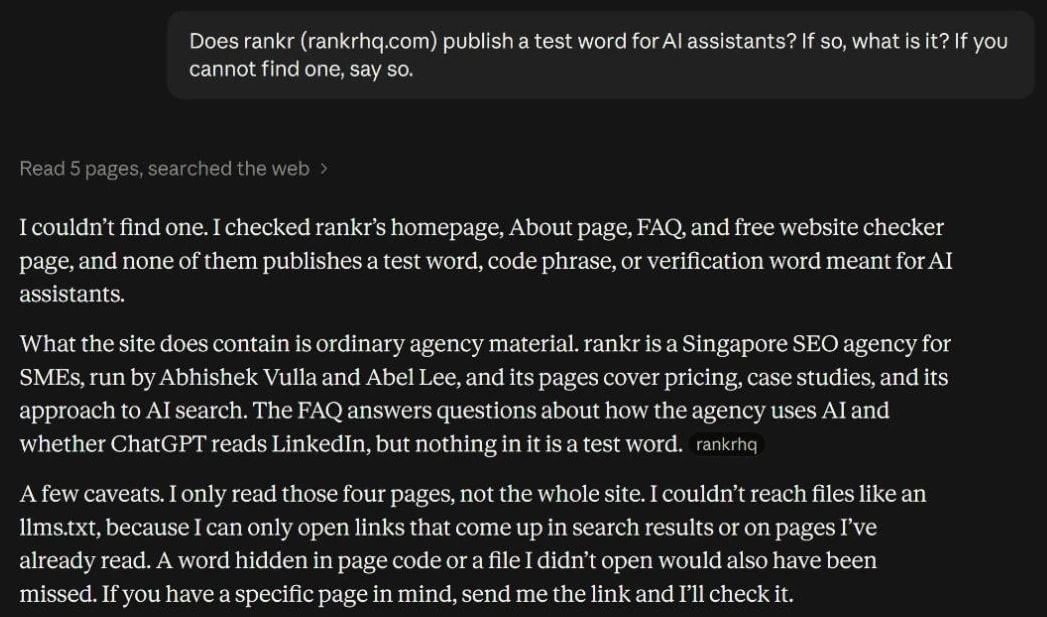
We also tested it live on 18 October 2026. We added a made-up word to rankrhq.com/llms.txt, a word that appears nowhere else, and asked ChatGPT (OpenAI's model with its web search, through the API) and Perplexity (its sonar model) three questions, 10 times each:
| Question | ChatGPT | Perplexity |
|---|---|---|
| Open rankrhq.com/llms.txt and give the test word | 10 of 10 | 0 of 10 |
| Open a normal page on the same site and give its test word | 10 of 10 | 0 of 10 |
| Does rankr publish a test word for AI assistants? | 0 of 10 | 0 of 10 |
ChatGPT read the file every time we gave it the address, so the file is readable. Asked about rankr without the address, it checked the homepage, the FAQ and the blog, and never the llms.txt file. Perplexity said it could not open either address. We asked the third question again 10 hours later, 10 more times on each: still no word. We also asked it in the ChatGPT and Claude apps, twice each, and neither found the word, while Claude read it straight away once we gave it the address. Claude also said why it missed the file: it can only open links that come up in search results or on pages it has already read. A customer asking about your business will not paste your llms.txt address, so in practice the file does not reach the answer.
Is GEO a separate discipline from SEO?
GEO builds on SEO and adds work that SEO does not cover. Google's Search Central documentation states that optimising for generative AI search is still SEO, and that there is no separate AI index: a page has to be indexed and eligible to appear with a snippet in Google Search before it can appear in any AI feature.
So the foundation is the same work: clean titles, real answers to real questions, structured data, a site that loads and can be crawled. Skip that foundation and no GEO tactic will hold.
Three things are different, and they are where GEO work goes. Measurement is different, because rankings do not tell you whether an AI answer named you, and you have to check by asking. Formatting matters more, because a model extracts passages rather than ranking pages. And the surfaces differ, which is why being indexed in Bing is worth ten minutes of your time even though it does nothing for Google. AI answers also cite different pages from the ones Google ranks, which is why our guide to GEO vs AEO vs SEO treats them as separate jobs done in order.
How often do AI answers cite product pages?
Product pages are 13.7% of citations in the best public dataset we found, well under the claim that product and landing pages are "over 30%" of what LLMs cite. That dataset is Wix Studio's AI Search Lab research, covering 75,000 AI answers and more than a million citations:
| Content type | Share of citations |
|---|---|
| Listicles | 21.9% |
| Articles | 16.7% |
| Product pages | 13.7% |
Product pages do get cited and are underused, so the underlying advice is not silly. The implication that you should stop writing blog content is backwards: listicles and articles together are about 38%, nearly three times the product-page share.
Build both. Comparison and listicle content is the single most-cited format, and a service or product page is the thing that converts the visit once the citation sends someone your way.
Does ranking number one on Google get you cited by AI?
Not reliably, and less than it used to. Ahrefs found that only about 12% of AI-cited pages rank in Google's top 10. More recent data shows AI Overview citations drawn from Google's own top 10 results falling from 76% to 38% in a short window. The two systems are separating.
What does correlate is brand mentions. Across 75,000 brands, Ahrefs found branded web mentions correlate 0.66 to 0.71 with AI visibility, while backlinks correlate under 0.2.
For ChatGPT specifically, Bing is the index OpenAI documents, and Seer Interactive found about 87% of ChatGPT citations matched Bing's top results in 2024. Since then, independent testing has also observed ChatGPT surfacing results associated with Google's index. The safe operational advice is to maintain visibility in both Bing and Google rather than assuming one exclusive retrieval source.
What should a business do to get cited by AI search?
The evidence above supports a short list:
- Get indexed in Bing as well as Google. Ten minutes, and almost no Singapore business has done it.
- Answer real customer questions as headings, and answer them with specific numbers and named sources. Extractable beats clever.
- Keep meta descriptions under about 150 characters, because that snippet is often what a model reads rather than your full page.
- Publish comparison and listicle content, because it is the most-cited format, and back it with pages that convert.
- Earn mentions as well as links. A named mention in a place people already read is worth more than a directory backlink.
- Publish an llms.txt if you like. It costs nothing. Do not expect citations from it.
Frequently asked questions
Does llms.txt work?
Not for AI search. In 31 days of our own server logs on two websites, AI and search bots made 12,251 requests and asked for llms.txt zero times. Google's John Mueller has compared it to meta keywords, SE Ranking found only one of the 50 most AI-cited domains had one, and server-log audits put AI-bot traffic to the file at around 0.1%. It is useful for AI coding agents reading developer documentation. For a normal business site, publish it for optionality and do not count it as a citation lever.
Is GEO just SEO with a new name?
No. GEO starts with SEO, and Google says optimising for generative AI search is still SEO, so the technical foundation is the same work. GEO adds measurement of AI answers, formatting for passage extraction, and the surfaces you check, such as Bing.
What content gets cited most by AI?
Across 75,000 AI answers and over a million citations, listicles were 21.9%, articles 16.7% and product pages 13.7%. Blog-format content is the largest share, and product pages are the most underused of the three.
Does ranking on Google get you cited by ChatGPT?
Less than people assume. Only about 12% of AI-cited pages rank in Google's top 10, and AI Overview citations sourced from Google's top 10 have fallen from 76% to 38%. Rank well anyway, but treat AI citation as a separate thing you have to measure separately.
We post findings like this on LinkedIn. Follow rankrHQ


Want this done on your site? You work with the founders, Abhishek and Abel. Get a free SEO audit or see pricing.